




“Earl, it’s nearly impossible to count them all,” says Lydia. “Too many. I keep losing track.”
Earl holds up a small branch, one of many in the driveway. He grips it firmly against the steady wind out of the southwest. Storm-damaged limbs and twigs from the oak and maples lie all around.
“Why?” he asks.
“Why what?”
“Why do you need to count them? The leaves?”
“I’m not counting leaves, Earl. I’m counting the trees. To tell the tree guy how many fell last night. So he can give us a rough estimate. Why would you think I’m counting leaves?”
“Dunno. Seems liked a pretty big task. You always liked big tasks, right? Seems big.”
Lydia stands, hands on hips, and stares at him. “That doesn’t make sense. Why would you think I’d be counting leaves?” She read not long ago that mature oaks can have a million leaves. Why would he say something like that?
“You okay?” she asks.
He glances up, still holding the branch in his hand. “Huh?”
“I mean it. You okay? Anything bothering you?”
He sets the branch gently to the side of the driveway then picks up another. “No,” he says. “I’m fine.”
She takes her lopper and cuts a branch overhanging the drive. It falls to the ground in front of her and she tosses it in the wheelbarrow. “I mean,” she says, “you been distant lately.”
He rubs his forehead with the back of his hand.
“I mean,” she says, “sometimes.”
He glances at her, bends slowly to retrieve a couple twigs, then tosses them to the side of the drive.
“I mean,” she says, “I don’t understand why you think I’d be counting leaves, for heaven’s sake. I thought it was pretty obvious I was trying to figure out how many trees are down. Why would you...” She pauses. “Why would anybody think that?”
“It’s just…,” he says. “it’s cause I like leaves, I guess. They’re all interesting. I wonder if they are like snowflakes. Each one different. No two alike. I don’t know. I thought you liked them, too.”
She picks up two leaves and holds them side-by-side, looking back and forth between them. “I do like leaves,” she says. She turns them over. Holding one on top of the other. Extending her hand in the sunlight and staring at the shadow they make on the drive. “Never thought too much about them, though,” she says. “They are similar but not the same, I’d imagine. It would take all day to see if any two are the same.”
“You always liked big tasks. We got all day.”
Lydia sighs. She turns to the driveway and starts counting the downed trees again.
“Seventeen, I think. After that storm in July, he charged us a couple hundred per tree, but these are mostly smaller. Still, it’s gonna add up.” She looks at Earl. “How much you think he’ll charge?”
Earl has laid six leaves side-by-side on the driveway in front of himself. “The veins are all the same but the edges are scalloped differently. Some might be damaged but most are intact. Maybe they are all different.”
“Earl, how much you think he’ll charge?”
“Who?”
“The tree guy.”
“To count the leaves?”
Lydia closes her eyes. “No, Earl. To glue all of the leaves back on the branches then nail all the trees back upright.”
His eyes widen. “They can do that?”
“No, Earl.”
“Think they charge per leaf? That could add up. There are so many of them. And they’re all different. At least I think they are. Can they get them all back in the right places?”
She walks over to stand next to him. They regard the six leaves he has arrayed on the bare patch of driveway by his feet.
“Come on, Earl. Why don’t you pick these up and bring them inside? I gotta call the tree guy and you can get a cup of coffee.”
Earl stacks the leaves on top of each other and grips them gently with both hands. He steps around a fallen branch and follows her back to the house.
Lydia holds open the side door, points Earl to his easy chair, then hears the screen door bounce shut behind her.
_____
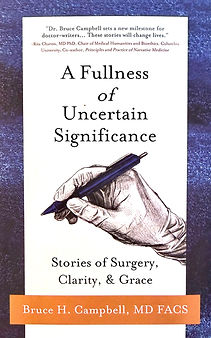
Bruce Campbell, MD FACS is a retired head and neck cancer surgeon. His book, A Fullness of Uncertain Significance: Stories of Surgery, Clarity, and Grace (TEN16 Press) was published in 2021.
_____
Thanks to my Monday afternoon Eagle River, WI writing group: Kate, Nancy one, Nancy too, Juliana, Sylvia, Pamela, and Bob.
______
"After the Storm - A short story" was initially posted to Substack on August 4, 2026


